
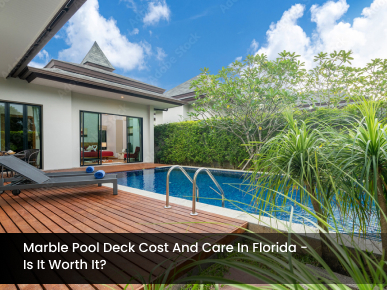
A marble pool deck can be worth the investment in Florida if you want a high-end look, a comfortable barefoot feel, and a long-lasting natural-stone surface. However, marble generally costs more than travertine and needs careful cleaning, sealing, and maintenance. Your decision should come down to cost, heat underfoot, upkeep, appearance, and how you’ll use the marble pool deck.
Marble brings a polished, upscale look to an outdoor space that is hard to replicate with standard concrete or pavers. Its natural veining gives each deck a distinctive look, making it especially appealing for homeowners creating a luxury pool area.
But appearance is only part of the decision.
A pool deck has to handle Florida’s intense sun, rain, humidity, pool water, sunscreen, dirt, and constant barefoot traffic. That’s why the right stone, finish, installation, and maintenance plan matter just as much as the color or pattern.
One of the biggest questions Florida homeowners ask is whether marble gets too hot.
Marble can stay relatively comfortable underfoot compared with some darker or heat-absorbing surfaces, especially when you choose a lighter stone and the right finish. However, no outdoor surface is completely heat-proof. Direct Florida sunlight can warm any hardscape, so cover heat underfoot.
For example, a light-colored marble surface around a pool may feel more comfortable than dark concrete in peak sun, but shade, stone color, orientation, and weather all affect how warm it feels.
Marble is generally a premium pool-deck material. Current Florida-area planning ranges put installed marble pool decking at roughly $22–$40+ per square foot, depending on the stone, finish, layout, site preparation, coping, demolition, and installation requirements. Some premium marble varieties can cost considerably more.
Pool Deck Size | Approximate Installed Cost |
500 sq. ft. | 11,000–20,000+ |
700 sq. ft. | 15,400–28,000+ |
1,000 sq. ft. | 22,000–40,000+ |
These numbers are only a starting point. Your actual project cost can be different depending on the property and installation.
Several factors can move the price significantly:
That’s why comparing only the material price per square foot can give you an incomplete picture.
When you’re weighing cost vs. travertine, marble will generally be the more premium option.
Travertine, meanwhile, has become a popular choice for pool areas because of its natural appearance and outdoor-friendly character. It can also provide a more relaxed, resort-style look.
Factor | Marble | Travertine |
Initial cost | Usually higher | Usually lower |
Appearance | Luxurious, distinctive veining | Natural, earthy, textured |
Heat underfoot | Generally comfortable with suitable selection | Known for comfortable barefoot use |
Porosity | Varies by stone | More porous |
Maintenance | Requires stone-specific care | Requires regular cleaning and sealing |
Acid sensitivity | High | High |
Design feel | Refined and upscale | Relaxed and resort-like |
Best for | Luxury-focused designs | Versatile pool and outdoor spaces |
The right choice depends on whether you value marble’s appearance and premium finish or travertine’s proven outdoor-pool practicality.
Marble needs more thoughtful maintenance than occasional surface spraying.
The cleaning product you use matters.
Avoid acidic cleaners such as vinegar on marble. Because marble is sensitive to acids, these products can cause etching and leave dull areas on the surface.
Sealing can help reduce the amount of water and oils absorbed into the stone. However, it doesn’t make marble completely stain-proof, nor does it prevent acid etching.
The right sealing schedule depends on the type of marble, exposure, traffic, and sealer used. Therefore, it’s better to check the condition of the stone instead of following a one-size-fits-all schedule.
One simple check is to place a small amount of water on the surface. If the water quickly absorbs instead of remaining on top, the stone may need to be evaluated for resealing.
Pool decks are different from indoor marble floors because people walk across them with wet, bare feet.
The finish matters. A highly polished surface may not be the right choice around a pool, so discuss texture, slip resistance, drainage, and sealer type before installation.
Marble can make sense if you want a distinctive, premium pool environment and are comfortable with the added investment and maintenance.
It may be worth considering when you want:
However, if your priority is keeping the initial investment lower, travertine or another pool-deck material may be a better fit for your project.
The goal isn’t simply to choose the most expensive stone. It’s to choose a surface that fits your home, budget, pool usage, and maintenance expectations.
At Vero Outdoor Living, we help homeowners create pool decks that work as part of the entire outdoor space not as an isolated surface.
Our hardscape services include pavers, travertine, and marble, so we can help you compare materials based on your property’s design, needs, and overall outdoor-living plan.
From material selection and layout to installation details, we can help you think through the practical side of creating a pool deck that looks right and functions well.
A marble pool deck can bring a beautiful, high-end feel to a Florida outdoor space, but it isn’t simply a matter of choosing the most luxurious-looking material. Cost, sunlight, maintenance, surface finish, safety, and installation all deserve attention.
If you’re comparing marble with travertine or other pool-deck options, Vero Outdoor Living can help you explore the materials and design possibilities for your outdoor space. A thoughtful material choice today can make the pool area easier to enjoy and easier to maintain for years to come.
Yes, marble can be a suitable pool-deck material when you choose the right stone, finish, installation method, and maintenance plan. It is particularly attractive for homeowners who want a premium natural-stone appearance.
Marble can become warm in direct Florida sunlight, just like other hardscape materials. However, lighter-colored marble may feel more comfortable underfoot than darker surfaces. Shade and the amount of direct sun also make a difference.
Generally, marble costs more than travertine because it is often positioned as a premium natural-stone option. However, the final price depends on the material selected, preparation, design, and installation.
Marble should not automatically be treated with the same pressure-washing approach used for concrete. Excessive pressure or unsuitable cleaning products can damage natural stone. Use stone-safe cleaning methods appropriate for the specific marble.
There isn’t one sealing schedule that works for every marble deck. The frequency depends on the stone, sealer, weather exposure, traffic, and how the surface is maintained. Checking the stone’s water absorption can help determine whether it needs attention.
Look at more than the appearance. Consider the cost, surface temperature, finish, wet traction, maintenance, sealing requirements, installation conditions, and how often the pool area will be used. Comparing marble with travertine and other materials can help you make a more practical decision.