
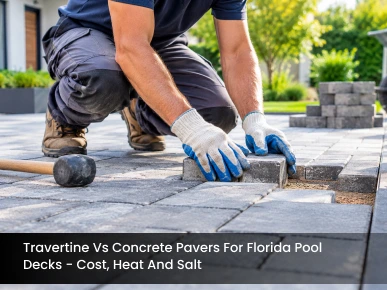
A pool deck should be beautiful, comfortable to walk on and able to withstand Florida’s hot, humid weather. When deciding between travertine vs pavers Florida pool deck options, homeowners often consider three main factors: cost of installation, surface heat and resistance to saltwater exposure.
Vero Outdoor Living compares travertine and concrete pavers in this guide to help you select a practical and stylish surface for your Florida backyard.
Lorem ipsum dolor sit amet, consectetur adipiscing elit. Ut elit tellus, luctus nec ullamcorper mattis, pulvinar dapibus leo.
Travertine is a natural stone with distinctive patterns and colour variations. Concrete pavers are manufactured and come in many shapes, sizes, colours, and patterns.
Feature | Travertine | Concrete Pavers |
Material | Natural stone | Precast concrete |
Appearance | Natural patterns and variations in color | Wide variety of colors, shapes and patterns |
Initial cost | Usually higher | Often more cost-effective |
Surface heat | Light colors can improve comfort | Depending on color, exposure and finish |
Repairs | May be difficult to match replacement stone | Individual units are often exchangeable |
Maintenance | Cleaning and proper sealing may be required | Cleaning and joint-sand maintenance may be required
|
Lorem ipsum dolor sit amet, consectetur adipiscing elit. Ut elit tellus, luctus nec ullamcorper mattis, pulvinar dapibus leo.
Travertine is a natural stone with distinctive patterns and colour variations. Concrete pavers are manufactured and come in many shapes, sizes, colours, and patterns.
Feature | Travertine | Concrete Pavers |
Material | Natural stone | Precast concrete |
Appearance | Natural patterns and variations in color | Wide variety of colors, shapes and patterns
|
Initial cost | Usually higher | Often more cost-effective |
Surface heat | Light colors can improve comfort | Depending on color, exposure and finish
|
Repairs | May be difficult to match replacement stone | Individual units are often exchangeable
|
Maintenance | Cleaning and proper sealing may be required | Cleaning and joint-sand maintenance may be required
|
The quality of the material, deck size, labor, site preparation, and installation technique all affect how much travertine and concrete pavers cost in Florida. Since travertine is a natural stone, its price is typically higher than that of concrete pavers.
Rather than comparing material prices alone, consider these cost factors:
Cost factor | What to consider |
Material | Stone type, paver quality, colour and finish |
Preparation | Excavation, grading and base installation |
Labour | Deck layout, cutting and installation complexity |
Drainage | Grading and any necessary drainage improvements |
Finishing | Joint materials, cleaning and suitable sealing |
Long-term care | Cleaning, repairs and periodic maintenance |
Prices vary between projects, so request a detailed quote for your specific property.
Travertine For natural stone, distinctive textures and a classic look by the pool, choose travertine. Opt for concrete pavers for a wider choice of colors and patterns, possibly lower initial costs and the convenience of replacing single units. Select a textured, slip-resistant finish and ask about heat, salt exposure and maintenance for either material.
Vero Outdoor Living provides pool deck solutions that enhance Florida homes and outdoor spaces. Check out its pool deck services for ideas on materials and designs for your backyard.
Travertine offers natural character and can be comfortable underfoot, while concrete pavers provide design flexibility and practical repair options.
Ready to upgrade your poolside space? Contact Vero Outdoor Living to explore pool deck options that suit your home and outdoor lifestyle. Visit verooutdoorliving.com to get started.
Travertine is a natural stone and fits traditional homeowners. Concrete pavers may be cheaper and more flexible.
Travertine may get hot in the direct sun, but lighter colors are often more comfortable than darker paving materials.
Yes, saltwater pools can have proper concrete pavers installed around them. Regular rinsing and maintenance appropriate to the product help to protect the surface.
Sealing can help reduce staining and moisture penetration. The right product and sealing schedule varies by stone, installation and manufacturer’s recommendations.
Individual pavers are generally easier to repair because they can be lifted and replaced. It is possible to repair travertine, too, but matching the original stone may be harder.