
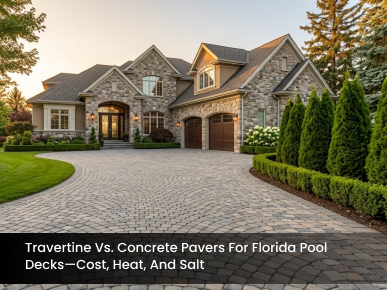
For a Vero Beach pool deck, concrete pavers run $7 to $12 per square foot installed and travertine runs about $12 per square foot more — roughly $19 to $24 installed. Travertine stays noticeably cooler underfoot, which matters on a deck that takes full Treasure Coast sun. Both work around saltwater pools. Below we compare the two on the three things that actually decide it: cost, heat and salt.
On a typical 600 square foot pool deck in Vero Beach:
Material | Per sq ft installed | 400 sq ft | 600 sq ft | 800 sq ft |
Concrete pavers | $7 – $12 | $2,800 – $4,800 | $4,200 – $7,200 | $5,600 – $9,600 |
Travertine | $19 – $24 | $7,600 – $9,600 | $11,400 – $14,400 | $15,200 – $19,200 |
So on a 600 square foot deck you are looking at roughly $7,000 more for travertine. That is the number to start from.
Two things change it. If you are tearing out an existing concrete deck, add about $1 per square foot for removal and disposal — around $600 on a 600 square foot job. And the layout matters: a running bond or simple pattern uses less material and less labour than a herringbone or a heavily bordered design.
Other factors that move the final figure:
Every one of those applies to both materials, so the roughly $12 per square foot gap between them holds fairly steady as the project scales.
If your pool deck gets strong afternoon sun and you walk it barefoot, yes — we think it usually is. The temperature difference is not subtle in July, and it is the thing homeowners comment on most after the job is done.
If the deck is mostly shaded, or the budget is the binding constraint, concrete pavers will serve you well and leave money for the paver patio installation or outdoor kitchen you also want. That is a real trade-off worth making deliberately.
We would rather quote you both and let you see the two numbers side by side. You can see both materials installed in our hardscape projects.
Travertine. Consistently.
It is a natural stone with low heat retention and it comes mostly in light, warm tones — ivory, walnut, silver — that reflect rather than absorb. On a Vero Beach afternoon in August, the difference between travertine and a mid-tone concrete paver is the difference between walking across the deck and hopping across it.
Concrete pavers are not automatically hot. A light-coloured paver in a partly shaded deck is perfectly comfortable. A dark charcoal paver in full sun is not.
Material is only part of it:
If your pool takes full sun from midday to evening, prioritise a light colour in whichever material you choose, and plan for shade over at least part of the deck.
Travertine, for the same reason — it stays cooler, and its naturally textured surface gives reasonable grip.
Concrete pavers with a tumbled or textured finish also grip well. What matters more than the material is the finish you pick: a smooth, highly sealed surface of either type will be slick when wet.
No pool deck material is slip-proof. Anyone who tells you otherwise is selling something.
Both work around saltwater pools. Neither is maintenance-free.
Pool water splashes onto the deck constantly. As it evaporates it leaves salt and mineral deposits behind. Left alone, in poorly drained areas, those deposits can stain the surface and over years contribute to deterioration.
Yes, with proper care. Travertine is a porous natural stone, so it needs sealing — typically every one to two years in our climate — and regular rinsing to stop salt building up in the surface pores.
Get the drainage right at installation and the maintenance is straightforward. Get it wrong and you will see staining in the low spots within a couple of seasons.
Also yes. Performance comes down to paver quality, the joint material used, drainage and routine cleaning.
Pavers have one practical advantage here: if a section does stain or damage, individual units can be lifted and replaced without disturbing the surrounding deck. Travertine can be replaced the same way, but matching a natural stone to the existing deck after a few years of weathering is harder — the colour variation that makes travertine attractive also makes replacements visible.
Factor | Travertine | Concrete pavers |
Installed cost | $19 – $24 per sq ft | $7 – $12 per sq ft |
600 sq ft deck | $11,400 – $14,400 | $4,200 – $7,200 |
Heat underfoot | Noticeably cooler; low heat retention | Depends on colour — light runs cool, dark runs hot |
Saltwater | Fine with sealing every 1–2 years | Fine with routine cleaning and good drainage |
Sealing | Required, ongoing | Optional; extends colour life |
Appearance | Natural stone, ivory to walnut tones | Wide colour and pattern range, uniform look |
Repairs | Individual pieces lift out, but colour-matching weathered stone is difficult | Individual pavers lift out and match cleanly from stock |
Design flexibility | Natural variation, limited colour range | High — many colours, shapes and patterns |
Neither is automatically right. The honest summary is that travertine buys you comfort and a natural look for roughly double the money, and concrete pavers buy you flexibility and budget headroom.
Marble is the third option we install, and it sits in similar territory to travertine on price. It gives the brightest, most reflective surface of the three and the most upscale finish.
If you are weighing all three, the deciding factors are the same — sun exposure, budget and the look you want. Call us and we will bring samples to the property so you can see them against your house and your existing hardscape.
We have been installing pool decks across Vero Beach and Indian River County for over 12 years, in pavers, travertine and marble.
We lay everything out on site rather than prefabricating, so you see the pattern and the colour against your actual house before we set it. We are licensed and insured, and we will give you a written quote for both materials on the same deck so you are comparing real numbers rather than estimates per square foot.
Want to see what your pool deck would cost in each? Request a free consultation or call 772-494-1622 and we will come out, measure, and bring samples.
Travertine runs about $19 to $24 per square foot installed. On a typical 600 square foot pool deck that is roughly $11,400 to $14,400, before any tear-out of an existing surface.
Yes. Travertine costs about $12 per square foot more than concrete pavers. Pavers run $7 to $12 per square foot installed and travertine runs $19 to $24
Yes. Travertine has low heat retention and comes in light natural tones, so it stays noticeably cooler underfoot. Concrete paver temperature varies with colour — a light paver runs cool, a dark one gets hot in direct sun.
Yes. Travertine works well around saltwater pools when it is properly installed with good drainage, sealed every one to two years, and rinsed regularly to prevent salt deposits building up.
Not when they are installed and maintained properly. Good drainage, quality joint material and routine cleaning prevent the salt and mineral deposits that cause staining over time.
Travertine, if barefoot comfort in direct sun matters to you. If you prefer concrete pavers, choose a light colour and plan shade over part of the deck.
Tear-out and disposal runs about $1 per square foot, so roughly $600 on a 600 square foot deck. That is on top of the new surface cost.